
Start here
How to start a line striping business
7-minute read · Figures checked October 2026
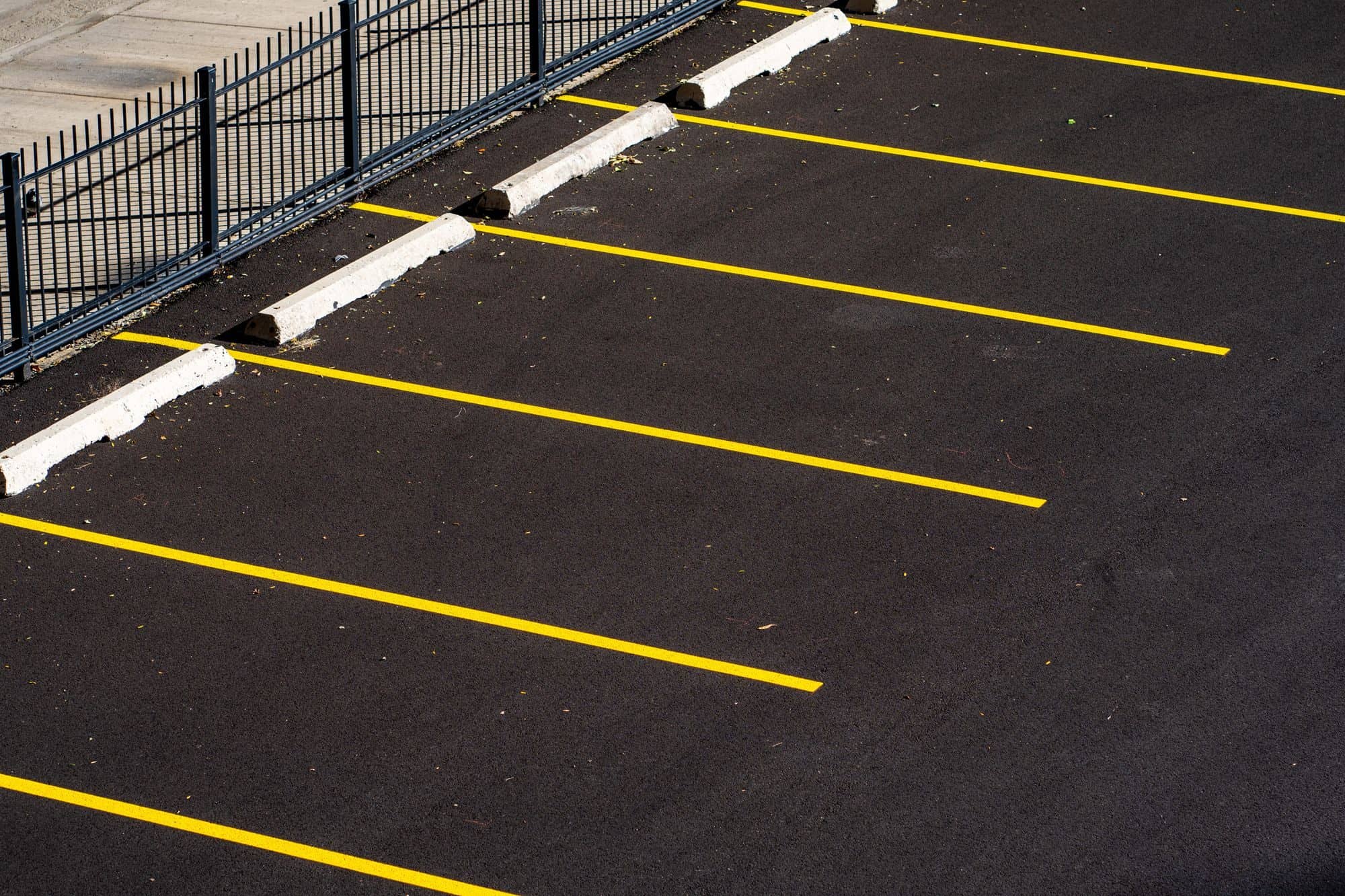
Photo: Otto Rascon / Pexels, Pexels License
The short answer
Start with restriping existing parking lots, and learn layout before you sell new layouts. Never assume the old lines were right: when a business restripes its lot, the accessible parking spaces have to meet the 2010 Americans with Disabilities Act (ADA) Standards. Match your paint to your machine, follow the label for weather and dry time, and leave public-road marking for later. The money and setup steps are in Business 100: Start Right, and the start hub has the full launch sequence.
Restriping, new layout and public roads
- Restriping repaints an existing layout: stalls, arrows, crosswalks and accessible spaces. Start here.
- New layout sets stalls and aisles on new pavement, or changes a layout, from a plan. Ask for the site plan, the markings the owner wants and who confirms the design. If nobody can confirm it, refer the design work out.
- Public roads are a separate business. Federal rules make the Manual on Uniform Traffic Control Devices (MUTCD) the national standard for traffic control devices on roads open to public travel, including roads through shopping centers. Parking areas and the driving aisles inside them are left out of that definition. Road jobs also bring traffic control: the Occupational Safety and Health Administration (OSHA) requires the devices that protect construction workers to conform to Part 6 of the MUTCD.
Even a restripe needs a check. The U.S. Department of Justice says a business that restripes must provide accessible spaces as the 2010 Standards require, and the U.S. Access Board's guide treats resurfacing or resealing a lot as an alteration.
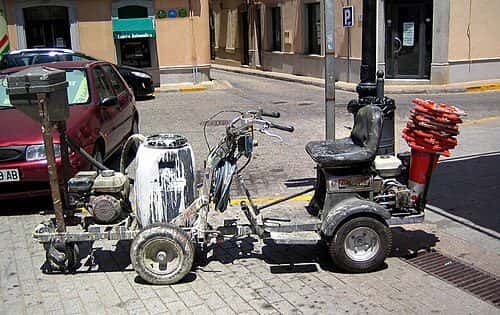
A walk-behind line striper with its paint tank.
Photo: Doalex / Wikimedia Commons, CC BY-SA 4.0

Accessible parking basics
These are the federal minimums from the Justice Department's restriping brief and the Access Board's guide. Your state or city can add more. Confirm the layout with the owner in writing, and flag anything that doesn't match.
| Total spaces in the lot | Accessible spaces required |
|---|---|
| 1 to 25 | 1 |
| 26 to 50 | 2 |
| 51 to 75 | 3 |
| 76 to 100 | 4 |
| 101 to 150 | 5 |
| 151 to 200 | 6 |
| 201 to 300 | 7 |
For bigger lots, use the full table in the restriping brief.
- Van spaces. At least 1 of every 6 accessible spaces, or fraction of 6, must be van accessible. So 7 accessible spaces need 2 van spaces.
- Widths. Car spaces are at least 96 inches wide, with an access aisle at least 60 inches wide. Van spaces are at least 132 inches wide with a 60-inch aisle, or 96 inches wide with a 96-inch aisle. Two spaces can share one aisle.
- Aisle markings. Mark the aisle so people won't park in it. The Standards don't set the color or method; state or local rules may.
- Signs. Each space gets a sign with the International Symbol of Accessibility, and van spaces add "van accessible." A lot with 4 or fewer spaces in all doesn't need the signs. Mount signs with the bottom at least 60 inches above the ground.
- Slope and location. Spaces and aisles can't be steeper than 1:48 in any direction, and they go on the shortest accessible route to an accessible entrance.
Paint won't fix a slope or a missing route, so tell the owner in writing before you stripe.
Example. Maya (example) restripes a 60-space strip-center lot. The table calls for 3 accessible spaces, and at least 1 must be van accessible. The old layout shows 2 accessible spaces and no van space. She shows the owner the table, gets a revised layout signed, and paints that one.
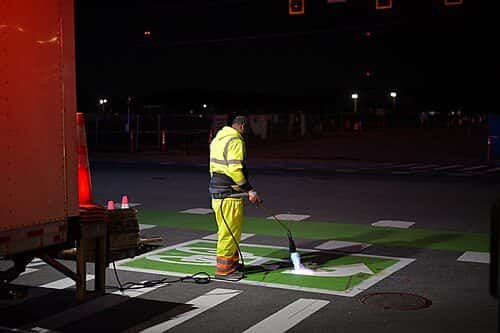
Thermoplastic markings are heated into place with a torch, a different process from painted stripes.
Photo: 4300streetcar / Wikimedia Commons, CC BY 4.0

Paint and equipment
The Texas Department of Transportation's marking handbook calls traffic paint the oldest and most widely used marking material. It says water-based paint has far fewer volatile organic compounds (VOCs) than solvent-based paint, is easier to handle and dries to no-track faster. Texas hasn't allowed solvent-based paint on its roads for years. Thermoplastic is a different system, solid at room temperature and applied hot with its own equipment. Leave it for later.
Federal rules cap VOCs in traffic marking coatings, a category that covers parking lot paint, at 150 grams per liter (1.3 pounds per gallon). Ask your supplier whether your state or air district sets tighter limits. Check that the paint fits your striper and its tips, and follow the label for weather limits and dry time.
Starting equipment: a walk-behind airless striper with tips for the line widths you'll paint (B100.4); stencils for arrows, numbers and the accessibility symbol; a measuring wheel and a long tape; a chalk line or string; a blower and broom; and cones and tape. Rent the striper for your first jobs.
Layout and measurement
- Before a lot is sealed, measure and photograph every line, and mark the line ends outside the area being sealed so you can put the layout back.
- Before you quote, count the stalls and check the accessible spaces against the table.
- On the job, blow the lines clean, snap chalk lines or pull string for long runs, and measure stall widths twice.
- Before you paint, spray a test pattern on cardboard to check the line width and edges.
- Watch the wind. Overspray on cars and curbs is a common complaint (B100.3).
First commercial work
Your buyers are property managers, businesses, churches and schools (B100.3). Two places to find work: sealcoaters who need lots restriped after they seal, and owners whose lines have faded.
Work when the lot is quiet: early mornings, evenings or days the business is closed, one section at a time behind cones. OSHA lists struck-by among the common hazards in highway work zones, and on a lot it's the driver who cuts through your cones. Wear a high-visibility vest, and park the truck where it shields the crew. Once you hire, OSHA requires you to keep the paint's label and safety data sheet (SDS) for your workers and train them to handle it.
Learn layout beside an experienced striper, or ask your supplier what training comes with the machine. Practice on an empty lot, with the owner's permission, before your first paid job.
Licensing depends on your state, county and city, says the U.S. Small Business Administration. California, for example, puts directional lines, markers, signs and arrows on parking facilities under its C-32 classification. Get insurance before the first paid job (B100.7). You can start on weekends while you keep your paycheck (B100.1). Report every dollar, cash included, as the IRS requires.
Your Move
Do this week
- Read the Justice Department's restriping brief and the Access Board's parking chapter.
- Get permission to measure one lot. Count the stalls and check the accessible spaces against the table.
- Ask a supplier which paint fits the striper you'd rent, and get its label and SDS.
- Call two sealcoaters near you and ask who restripes their lots.
Log it: I measured my first lot.
Frequently asked questions
How do I start a line striping business?
Start with restriping. Learn layout and the accessible parking basics, and rent a walk-behind striper for your first paid jobs. Then budget, register, license and insure the business (B100.4 to B100.7).
What's the difference between restriping and a new layout?
Restriping repaints an existing layout. A new layout sets stalls and aisles from a site plan. Either way, the accessible spaces have to meet the 2010 ADA Standards.
How many accessible (ADA) parking spaces does a lot need?
It depends on the total: 1 accessible space for 1 to 25 spaces, 2 for 26 to 50, 3 for 51 to 75, and so on. At least 1 of every 6 accessible spaces, or fraction of 6, must be van accessible.
What paint do parking lot stripers use?
Traffic marking paint, water-based, or solvent-based where it's allowed. Match it to your striper and follow the label.
Do I need a license to stripe parking lots?
It depends on your state, county and city. California, for example, covers this work under its C-32 classification.
Watch out for
- Painting over an old layout without checking the accessible spaces.
- Telling a customer their lot meets the ADA. Paint to an approved plan and put open questions in writing.
- Taking public-road work before you know the MUTCD and your state's rules.
- Paint that doesn't fit your machine, or striping outside the label's weather limits.
- Overspray when the wind picks up.
Free help
- ADA.gov: ADA compliance brief: restriping parking spaces
- U.S. Access Board: Parking spaces
- 2010 ADA Standards for Accessible Design
- OSHA On-Site Consultation: no-cost, confidential safety help for smaller businesses
- Small Business Development Centers: no-cost business consulting
Related guides
This is general education, not tax, legal, investment or insurance advice. Rules change and every situation is different. Check the sources below, and talk to a qualified professional before you act on it.
Sources
- U.S. Department of Justice, ADA.gov: ADA compliance brief: restriping parking spaces
- U.S. Access Board: Guide to the ADA Standards, chapter 5: parking spaces
- eCFR: 23 CFR 655.603, standards (the MUTCD as the national standard)
- OSHA: 29 CFR 1926.200, accident prevention signs and tags; Highway work zones and signs, signals, and barricades
- Texas Department of Transportation: Pavement marking handbook, section 4: material descriptions; Water-based paint: material characteristics
- eCFR: 40 CFR part 59, subpart D, VOC emission standards for architectural coatings
- OSHA: Hazard communication
- U.S. Small Business Administration: Launch your business
- California Contractors State License Board: C-32 Parking and Highway Improvement Contractor
- IRS: Filing tips and updates for gig economy workers